
MMCA - Make Mike Cornhole Again
For Humanity

Cornhole (also known regionally as sack toss, bean bag toss, or bags) is a lawn game popular in North America in which players or teams take turns throwing fabric bean bags at an inclined board with a hole in its far end. The goal of the game is to score points by either landing a bag on the board (one point) or putting a bag through the hole (three points).

History
The game was first described in Heyliger de Windt’s 1883 patent for “Parlor Quoits”, which displays most of the features of modern cornhole, but uses a square hole.[1] Quoits is a game similar to horseshoes, played by throwing steel rings at a metal spike. Several earlier “parlor quoits” patents had sought to re-create quoit gameplay in an indoor environment,[2] but De Windt’s was the first to use bean bags and a slanted board with a hole as the target.
He sold the rights to the game to a Massachusetts toy manufacturer which marketed a version of it under the name “Faba Baga”.[2] Unlike modern cornhole, which has one hole and one size of bags, a Faba Baga board had two different-sized holes, worth different point values, and provided each player with one extra-large bag per round, which could score double points.
In September 1974, Popular Mechanics magazine published an article written by Carolyn Farrell about a similar game called “bean-bag bull’s-eye”.[3] Bean-bag bull’s-eye was played on a board the same width as modern cornhole boards (24 in [60 cm]), but only 36 in [90 cm] long as opposed to the 48 in [120 cm] length used in cornhole. The hole was the same diameter (6 in [15 cm]) but was centered 8 in [20 cm] (rather than 9 in [23 cm]) from the back of the board. Each player threw two bags, weighing eight ounces (230 g) each, “in succession”. The boards in bean-bag bull’s-eye were placed “about 30 ft . [9 m] apart for adults, 10 ft . [3 m] for kids.” Scoring was essentially the same as that used in cornhole (three points for a bag in the hole, one point for a bag remaining on the board) and also used cancellation scoring.
In the Chicago area, a similar game is referred to as “bags” or “bean bags”, but uses rectangular bags. The game spread in Chicago, Illinois, and the Northwest region of Indiana in the late 1970s and early 1980s, perhaps due to the Popular Mechanics article mentioned above. Cornhole as it is now known originated and gained popularity on Cincinnati’s west side (near Ferguson Avenue) in the 1980s and spread to surrounding areas in Kentucky and Southeast Indiana.[4][5]

Tournaments
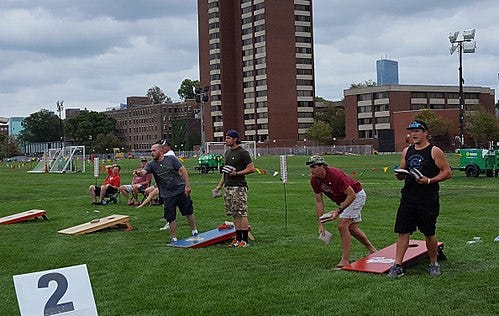
The American Cornhole Organization (ACO) was established in 2005 by Frank Geers and is headquartered in Milford, Ohio. The ACO claims on its website to be the “governing body for the sport of cornhole”.[6]
The American Cornhole League (ACL) was founded in 2015 by Stacey Moore. According to the ACL’s website, it promotes and develops cornhole as a sport on every level, and created software and apps to manage cornhole leagues, tournaments, special events, and player development.[7]
The American Cornhole Association (ACA) is an organization whose sole mission is to help cornhole players enjoy the game of cornhole. According to its website, “[o]ne of the most important ways to achieve this goal is for people to have high-quality equipment to play on.”[8] Accordingly, the ACA is largely focused on selling cornhole-related products and equipment rather than acting as a sanctioning body of the sport; however, it does have its own rules and does sponsor events.
The United Kingdom Cornhole League (UKCL) was founded in 2021 by Daniel Lilley. It promotes competitive tournaments across the United Kingdom and develops cornhole as a sport.
Rules and format
Equipment and court layout
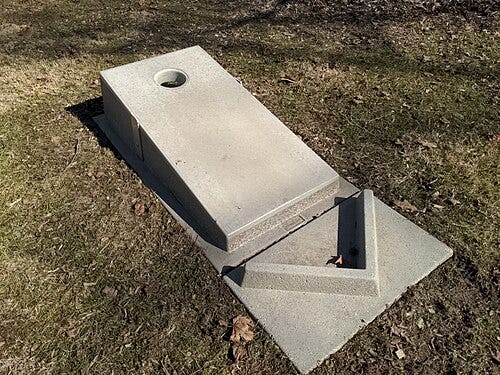
Cornhole matches are played with two sets of four bags (eight total), two boards and two, four, or eight players.[9][10]
There are four bags in a set. Each set of bags should be distinguishable from the other, usually by using different colors. The American Cornhole League’s rules call for double-seamed fabric bags measuring 6 by 6 inches (150 by 150 mm) and weighing 15.5 to 16.5 ounces (440 to 470 g).[10] Although bags used to be filled with preserved corn kernels (hence “cornhole”) or dried beans, the American Cornhole Organization developed bags filled with plastic resin or other materials that will maintain a consistent weight and shape over many throws without deforming.[9] Bags are usually dual-sided, with each side of the bag being a different material that can affect grip and react faster or slower on the board’s surface. Faster bags are often preferred in humid conditions when bags will not slide as readily. Additionally, professional players may opt for different materials depending on their personal throwing styles. Players with a lower, faster throw may use more rotation and prefer a slower bag material, whereas players with higher, slower throws may use less rotation and prefer a more reactive bag.
As per the American Cornhole Organization Rules, each board is 2 by 4 feet (0.61 by 1.22 m), with a 6-inch-diameter (15 cm) hole.[9] The hole’s center is positioned 9 inches (230 mm) down from the center of the top edge of the board. Each board is angled with the top edge of the playing surface 12 inches (300 mm) above the ground, and the bottom edge 3–4 inches (76–102 mm) above the ground. A standard court places the two boards 33 feet (10 m) or 27 feet (8.2 m) apart, measuring from the bottom edge of the boards. Different (usually shorter) distances may be used if space is limited or if younger players are participating.[9][10] Some smaller versions of the game, with scaled-down boards, bags, and holes are available specifically for children.
The areas immediately to the left and right of the boards are the pitcher’s boxes. The line (either drawn or imaginary) extending from the bottom edge of the board in both the left and right direction is the foul line. When throwing the bags, players cannot step past the foul line or else the throw does not count.
Cornhole: a bag that falls in the hole and is worth three points. Also known as a Drano, named for a drain-clearing product;[17]
Dirt bag: a bag that is on the ground or is hanging off the board and touching the ground.[18]
Frame: an inning, a single round during which a player or team and their opponent(s) all throw their bags.
Four-bagger: when a single player gets four bags in the hole in a single round. The bags can be knocked or pushed in by a player as well as their opponent as long as all four of the player’s bags go in the hole.
Grand bag: when a player makes all four bags in the hole directly, one after another, during an inning; differs from a four-bagger in that a bag is not later knocked from the board’s surface into the hole during the inning.
Flop bag, floppy bag: type of toss that does not spin the bag horizontally or vertically, a bag without rotation or spin.[21]
Hammer: when one or more hangers (see below) are around the hole, a hammer can be used; a hammer is a bag thrown as an airmail bag with a high arc in an attempt to move hanger bags into the hole along with it.
Hanger: a bag on the lip of the hole close to falling in.[17][18]
Honors: the player or team who tosses first, resulting from the team scoring in the previous inning or winning the coin toss before the first inning.[18]
Hooker: a bag that hits the board and while hooking or curving around a blocker goes into the hole.[17]
Jumper: a bag that strikes another bag on the board causing it to jump up and into the hole.[17]
Push, wash: when each player or team obtains an identical score in an inning resulting in no overall score change.[19]
Short bag: when a bag lands on the ground just before the board.[21]
Skunk, whitewash, shutout: a game that ends in a score of 21 (or more) to zero; by some unofficial rules a game may be called once a shutout score of at least 11–0 is reached.[17][18]
Slide, slider: a bag that lands in front of the hole and slides in.[17][18]
Swish: a bag that goes directly in the hole without touching the board (see also: “airmail”).[18]
Woody: any bag that has been pitched and remains on the board’s surface at the end of the inning (scoring one point).[19]
De Windt, Heyliger Adams. “US Patent 285,396 - Parlor Quoits”. Google Patents. Retrieved April 11, 2017.
Jensen-Brown, Peter (August 27, 2016). “Parlor Quoits, Bean-Bags, and Faba Baga – a History of “Cornhole” (the Game)”. Early Sports ‘n’ Pop-Culture History Blog. Retrieved April 11, 2017.
“Four projects you’ll find fun and handy: Bean-bag Bull’s-eye”. Popular Mechanics. Hearst Magazines. September 1974. p. 138.
Jack Heffron (May 1, 2008). “Tossing One Back”. Cincinnati Magazine.
“What is a Cornhole Game?”. GeometryDash.co.uk. Retrieved January 10, 2026.
“American Cornhole League”. americancornholeleague.azurewebsites.net.
“Cornhole Boards | Official Cornhole Boards | Regulation Cornhole Board”. American Cornhole Association.
“Official Rules for the Sport of Cornhole”. American Cornhole Organization.
“How to Throw Cornhole – Tips, Technique, and Strategy”. May 1, 2020. Retrieved July 14, 2024.
“Beyond the Basics Pt. 2 - Types of Cornhole Shots”. American Cornhole Association. Retrieved July 15, 2024.
“Cornhole World Rankings”. American Cornhole Organization.
“American Cornhole League”. www.iplaycornhole.com. Retrieved July 15, 2024.
“Wicked Wood Games World Championship”. www.wickedwoodgames.com.
“Cornhole Lingo”. Archived from the original on February 13, 2010. Retrieved September 16, 2008.
Shauna Scott Rhone. “By any name, game’s appeal spreading quickly”. Retrieved October 10, 2008.
“Cornhole Glossary – List of terms & explanation”. www.wickedwoodgames.nl.
“Learn How to Play Cornhole”. Cornhole Central. Retrieved January 15, 2021.
“Cornhole Terminology”. Retrieved February 28, 2016.